
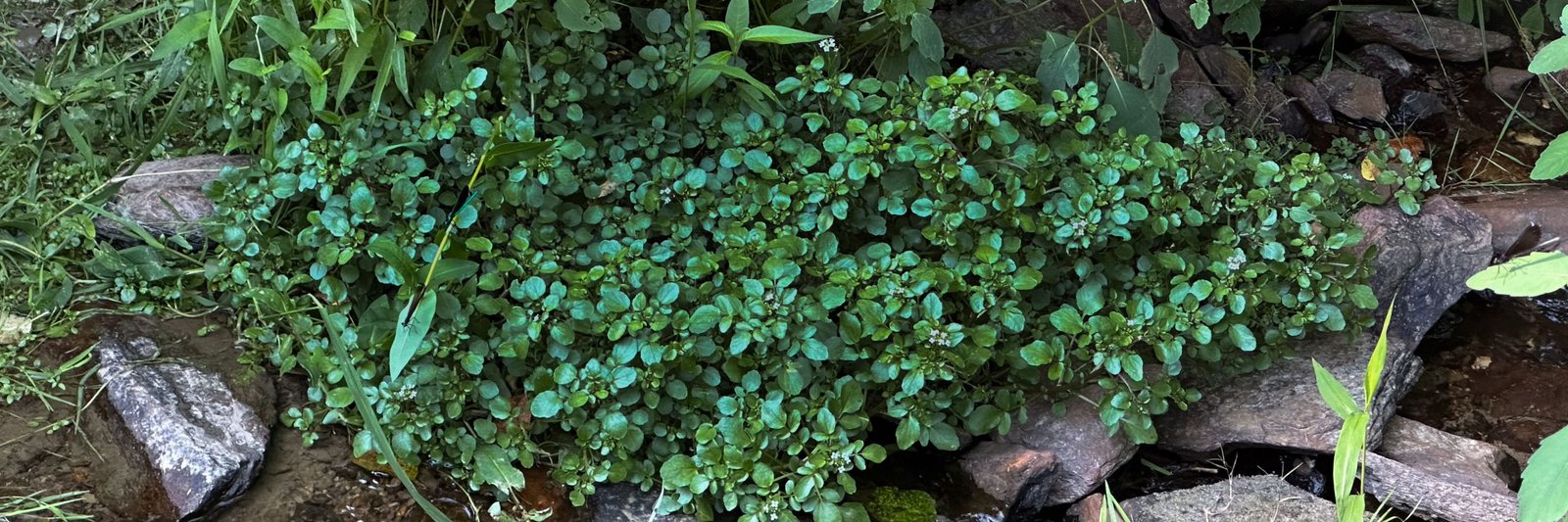
THE WORK / WORKING WITH WATER
Return water to its journey.
At Dark Hollow, water is not something to hurry away.
FIELD NOTE / THE RECEIVING PLACE
The hollow is not a problem to solve. It is a relationship to enter.
Dark Hollow lies in a fold of land between the hilltop and the river, in a place local folk have long called “the gutter.” Water arrives from the slopes above, forest springs, and heavy rain, then continues toward the river below. We meet it here in passage—receiving what higher ground releases before passing it onward.
Water is more than a resource passing through the landscape. It carries, dissolves, joins, reflects, and continually takes new form. Wherever it moves, it participates in shaping life.
Our work begins with practical gestures: slowing water, spreading it across the land, filtering it through roots and soil, and giving it time to enter the ground. But those gestures also begin with reverence. Water is sacred, vulnerable, and essential. How the land receives it matters.
Water reveals the shape of the land. Working with it begins by paying attention.

THREE MOVEMENTS
Slow it. Spread it. Sink it.
Slow
Branches, logs, roots, vegetation, and small obstructions take energy out of moving water. Less speed means less cutting and carrying of soil.
rain / resistance / patience
Spread
Water is encouraged to move sideways through the landscape rather than concentrate into a narrow, erosive channel.
contour / dispersal / contact
Sink
Time and contact allow water to infiltrate, recharge the ground, feed perennial roots, and remain present after the storm has passed.
soil / recharge / life
ON THE HILLSIDES
Returning the hillside’s missing bones.
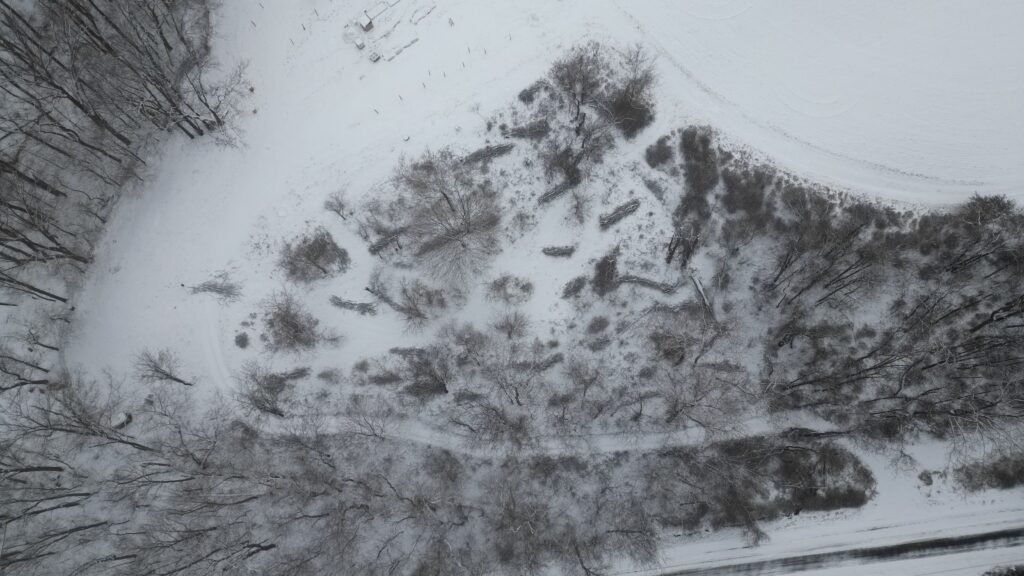
Across the hillsides, hundreds of feet of check dams built from logs, branches, and accumulated debris restore forms of resistance once supplied by fallen trees lying across the slope. Their placement is deliberate: we walk the land during and after rain, watch where flow gathers and soil begins to move, then return missing structure along contour.
These structures become biological engines. Layered wood and leaf litter hold moisture and offer shelter to fungi, insects, birds, and other animals. As the material decomposes, it feeds the soil, catches seed, and creates protected conditions where groundcover can establish. Structure becomes habitat; decomposition becomes fertility.
This is manipulation, but not command. It is collaboration with slope, gravity, decay, and water’s own revealed paths. The check dams settle, gather sediment, grow vegetation, and change with the land. Under the canopy, berms and woody material extend the same practice: small interventions that give water more time with the place.
Try. Watch. Learn. Then return after the next rain.
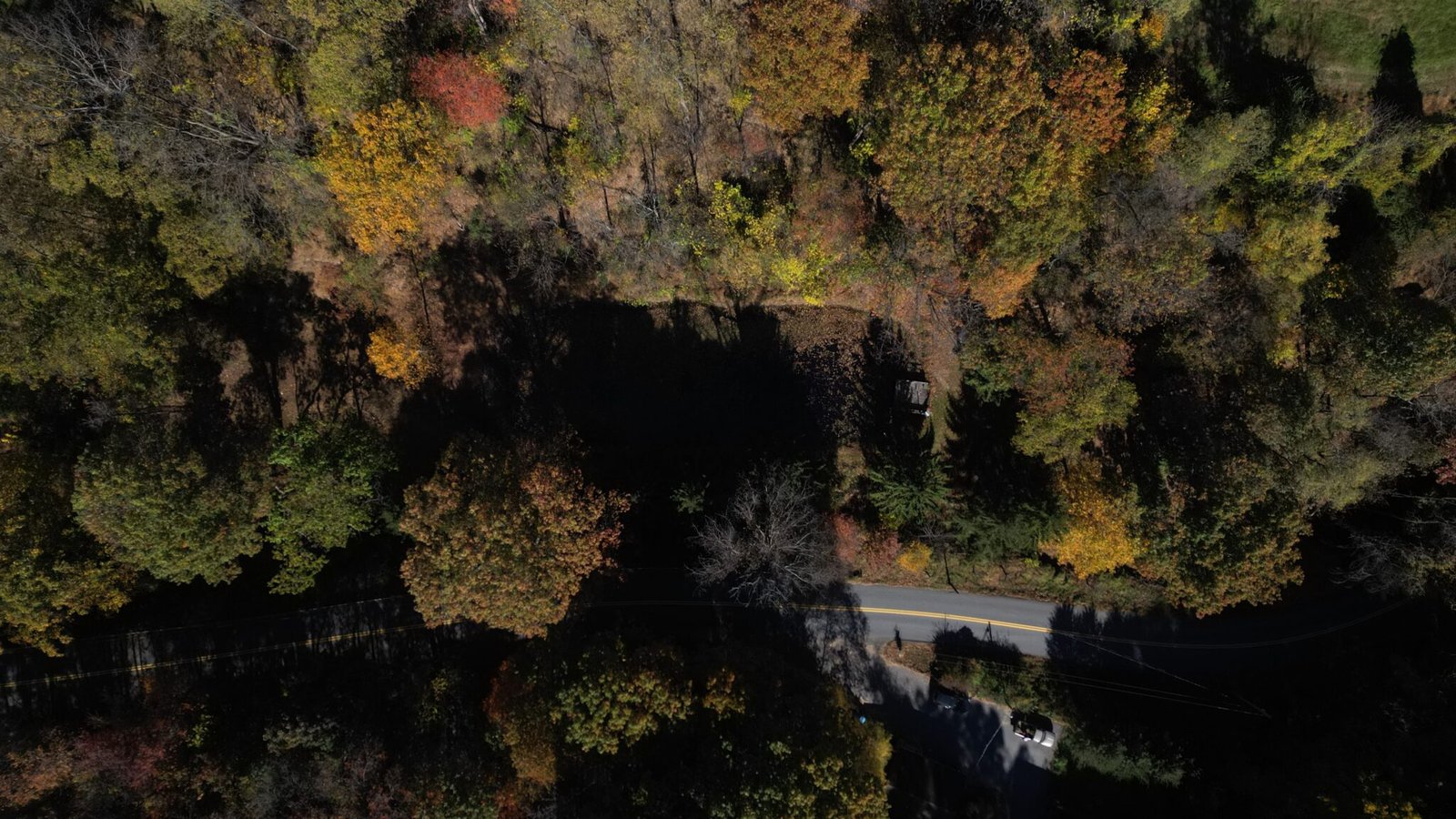
THE LONGER VIEW / A LIVING MEDIUM
Water does not merely occupy a place. It reveals relationships.
Theodore Schwenk learned to read water through its gestures: spirals, vortices, meanders, rhythmic exchange, and the continual meeting of movement and resistance. He insisted that “water is more than a mere flow of energy or a useful means of transport.” Its forms are not decoration laid upon it; they arise from its activity.
Wolfram Schwenk carried that work toward questions of water quality and creative practice. In his account of working with flowforms, “The creative process then takes place in the water itself.” The form does not command the water. It offers conditions through which water can answer.
Jennifer Greene carried the Schwenks’ work forward, including working directly with Wolfram Schwenk. Through accessible experiments and teaching, she has invited people to observe water’s movements for themselves—not as specialists seeking mastery, but as participants capable of developing attention, relationship, and reverence for water.
Reverence for water begins by learning to understand what water is trying to tell us.
JENNIFER GREENE / A FOURFOLD RELATIONSHIP
Four ways we meet the same water.
Jennifer Greene describes our relationship with water as fourfold: sanctity, nutriment, recreation, and waste stream. These relationships coexist uneasily. We depend upon water for life, seek renewal beside and within it, recognize something sacred in its presence—and then rely upon its extraordinary capacity as a solvent to carry away what we no longer want.
Sanctity
Water carries an ancient sacred significance. Attention to its sensitivity, beauty, and formative power can awaken reverence.
Nutriment
Water enters us and sustains every living process. The water we drink is not separate from the water moving through soil, plants, animals, clouds, and rivers.
Recreation
We return to water to play, rest, and become renewed—to re-create ourselves. Its movement restores movement within us.
Waste Stream
Because water dissolves, cleans, and carries, we ask it to receive our waste. This practical relationship becomes dangerous when it eclipses the other three.
“You do not defile what you have come to revere.”
Jennifer Greene
PREREQUISITE / LEARNING TO SEE
Sensitive Chaos belongs before the shovel.
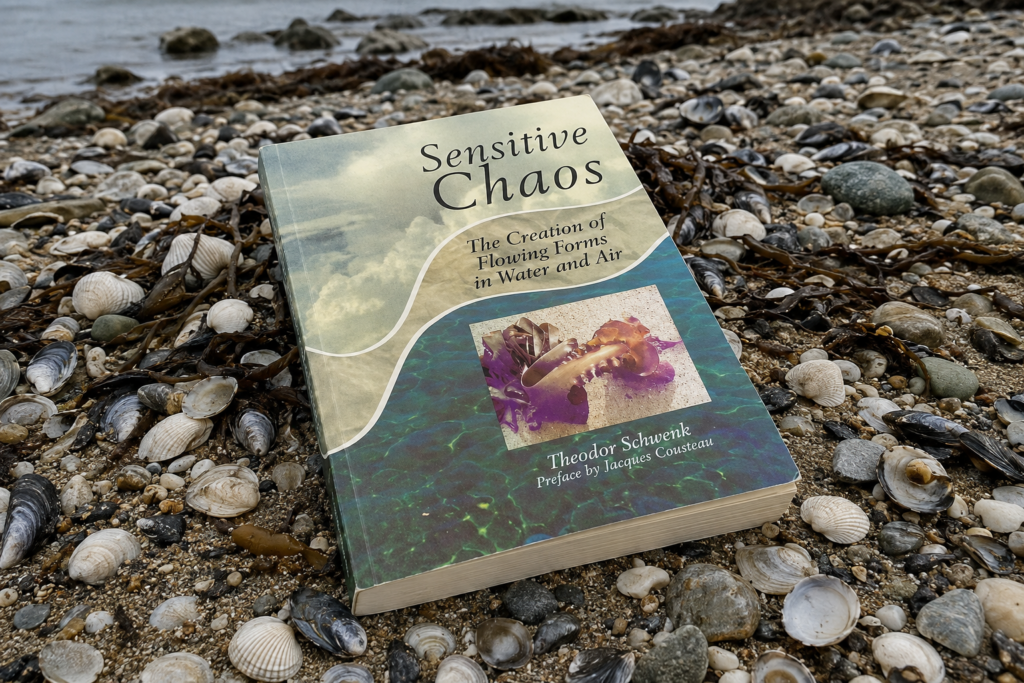
Theodore Schwenk’s Sensitive Chaos: The Creation of Flowing Forms in Water and Air is a must-read prerequisite for anyone undertaking serious water work. It trains attention on the archetypal movements that appear in rivers, weather, plants, organs, and living bodies.
This is not background philosophy added after a project is designed. It changes the quality of the work itself. Before deciding where water should go, we practice seeing how it moves, what it encounters, and which forms arise from that meeting.
Before shaping water, learn to see how water shapes.
As an Amazon Associate, Dark Hollow may earn from qualifying purchases.
An observation in moving water
The Train of Vortices
Move steadily through the liquid with your mouse or finger, as though drawing a slender stick through a shallow tray. Then release and watch the forms continue their journey.
This is an interpretive simulation—nowhere near as accurate or interesting as the physical experiment. You are encouraged to play, observe, and develop a relationship with water, the element of life.
THE PHYSICAL EXPERIMENT
Try the experiment at home
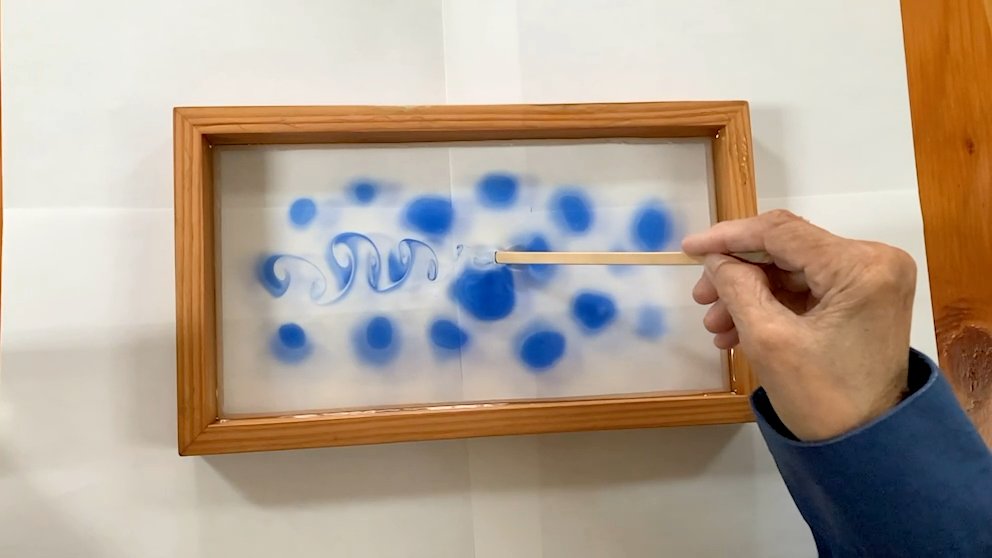
Mix corn syrup with water until the water moves more slowly—about one part corn syrup to five parts water. Pour the mixture into a shallow tray, using only enough to cover the bottom. Make sure the tray rests perfectly still on a sturdy surface. Carefully place several drops of water-based dye in the liquid, then draw a slender stick steadily through them.
What are we observing?
Schwenk, Greene, and other water researchers follow the recurring gestures of moving water: spiraling, meandering, oscillating, separating, and returning. This experiment makes those otherwise invisible movements perceptible. A straight gesture does not leave a merely straight result; water answers it rhythmically, forming alternating vortices whose character changes with speed, viscosity, and the smallest variation in movement.
FLOWFORMS / RHYTHMIC WATER
A pipe gives water a route. A flowform gives water a journey.
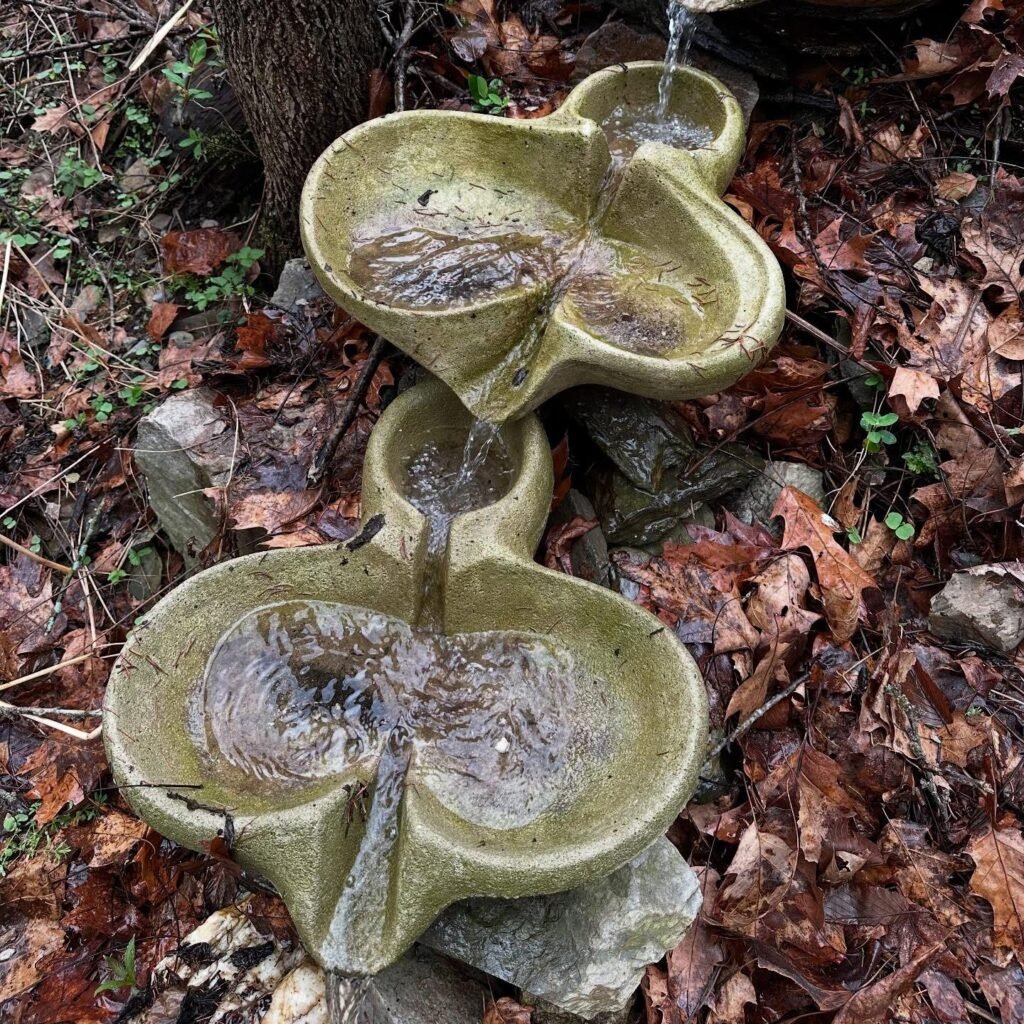
A flowform is a sculpted vessel—often a sequence of paired basins—shaped so that a steady stream begins to swing from side to side. Water folds through alternating vortices and may trace a lemniscate, or figure eight, meeting resistance, air, surface, and itself before continuing onward.
Flowform work grew from the same anthroposophical study of living movement that informs biodynamics. Its pulse echoes the stirring of biodynamic preparations, where an ordered vortex is repeatedly released into chaos and gathered again in the opposite direction. A flowform is not required biodynamic equipment; the kinship lies in rhythm, polarity, and respect for water as an active participant.
Conventional drainage asks water to leave as efficiently as possible. The flowform makes another gesture. It lengthens the encounter. Water is allowed to turn, breathe, gather, disperse, and arrive differently… not racing toward an exit, but journeying through a sequence of relationships. Fast water is destructive, still water is lifeless. Most often, nature moves water in a perfect balance between the two.
The purpose is not to make water perform. It is to give movement room to revitalize.
THE PRACTICE OF QUESTIONS
Questions keep the possibilities alive.
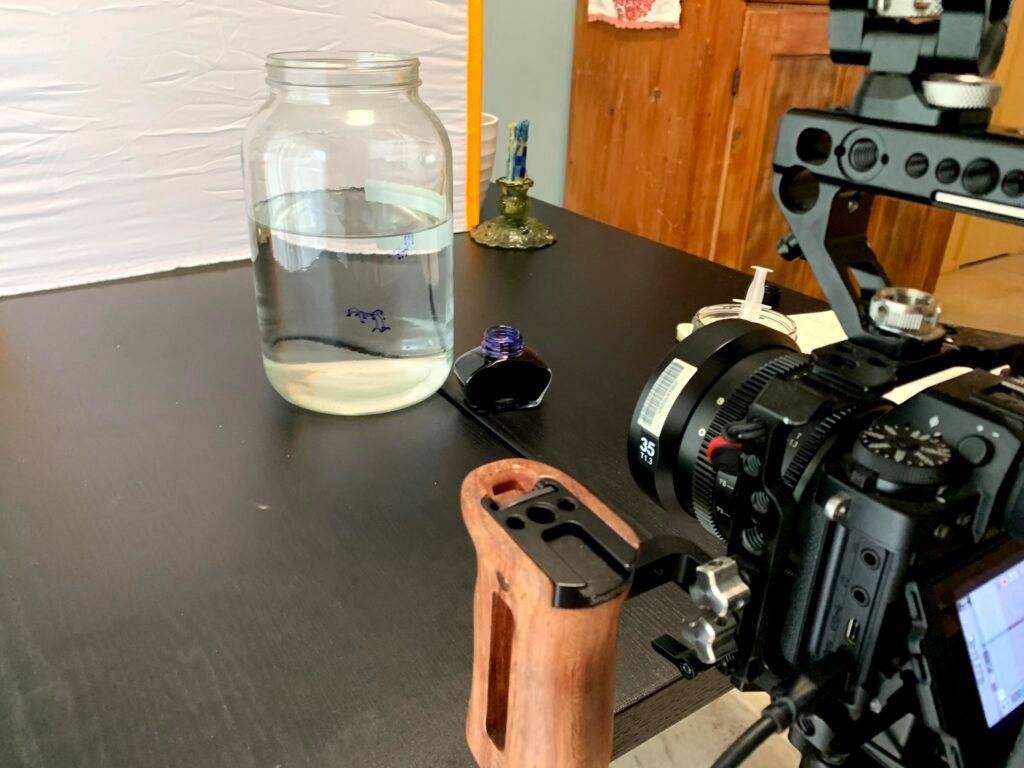
Jennifer Greene’s work has taught us that water research need not begin with an answer waiting to be proven. It can begin with attention: a vessel, still water, a drop of pigment, and enough patience to watch unfamiliar forms appear.
The value of an observation is not always that it closes a question. Sometimes it reveals that the question was too small. Water continually presents more relationships, more movements, and more possibilities than our first explanation could contain.
So the work remains open. We build, watch, ask, and return. Each rain, experiment, and change in the land becomes another opportunity to replace certainty with a more faithful question.
Not every question is waiting for an answer. Some are opening a field of possibility.
AN INVITATION
Watch the water during the rain.
Watch the edges of paths, the undersides of slopes, and the places where flow gathers. Then return after the storm to read the small deposits of leaves and silt. Water draws its map through movement and residue.