
A DARK HOLLOW FIELD POSITION
No plant is our enemy.
Our view of native, non-native and “invasive” species.
A multiflora rose did not invade anything.
People brought it here. Government agencies and conservation programs promoted it for living fences, erosion control, windbreaks and wildlife habitat. Farmers and landowners were encouraged to plant it as a useful response to problems people had created or were trying to solve.
Birds then carried its seeds beyond those intended plantings. Roads, abandoned fields, forest edges and disturbed soils offered new opportunities for it to grow.
Eventually, the qualities for which people had valued multiflora rose, its vigor, dense growth, abundant fruit and ability to thrive in damaged places, became the evidence against it.
Now we call it an invader.
That word can identify a real ecological problem. Multiflora rose can suppress regeneration, close pastures and diminish relationships native plants have formed over immense stretches of time.
But the word can also erase our part in the story. Nature was balanced, an outsider arrived and our responsibility is to destroy the culprit.
The history is rarely so innocent.
A plant can be out of relationship without being our enemy.
RESPECT IS NOT PASSIVITY
Management may be necessary. Contempt is not.
At Dark Hollow, we plant and protect native species. We cut vines, graze aggressive vegetation and sometimes remove plants that are overwhelming the relationships we want to cultivate.
If Oriental bittersweet is pulling down a young tree we are trying to establish, we cut it. If multiflora rose is closing a meadow or preventing woodland regeneration, we intervene.
But there is a difference between limiting a plant and declaring war on it. Words such as alien, invader, pest and enemy teach us how to approach a living being. Once a plant becomes an enemy, almost any violence against it can begin to feel virtuous.
THE POLITICS OF BELONGING
The metaphor does not remain in the field.
The language we use for plants is not politically innocent.
Alien. Foreign. Invader. Aggressive. Taking over. Does not belong. Must be eradicated.
These words belong to ecology, but they also belong to the language through which people have divided the human world. The same story appears again and again: an imagined homeland was once whole and pure; outsiders crossed its borders; their presence now threatens the lives that properly belong there.
Taken far enough, that story becomes the ecological posture of white nationalism: purity defended through exclusion.
This does not mean that protecting native plant communities is equivalent to racism, or that introduced species cannot cause serious ecological harm. Plants and people are not interchangeable, and responsible land management requires distinctions.
But metaphors train the imagination.
When we repeatedly describe the living world through invasion, contamination and eradication, we should notice what kind of human politics that language makes familiar. We should be especially cautious when belonging is determined entirely by ancestry, purity is treated as health and violence begins to feel like restoration.
We can protect longstanding ecological relationships without rehearsing a fantasy of purity.
We can respond to harm without learning to hate the life before us.
THE INTELLIGENCE OF DISTURBANCE
Removal without a living replacement is often only another disturbance.
Nature is brilliant.
The familiar invasion story asks us to imagine a colonizer’s boot carrying a foreign seed into an intact landscape, where it escapes and begins taking territory.
That happens. But the story is often much subtler.
People clear forests, compact soil, straighten streams, suppress fire, remove grazing animals, disturb the ground and alter the movement of water. Then a plant capable of living within those new conditions arrives and fills the opening.
We notice the plant.
We are less likely to notice the invitation.
A plant does not appear in a place for no reason. It is responding to soil, water, light, disturbance and the lives, or missing lives, around it. What we call an invasion may also be the landscape’s intelligent response to a wound.
A vine pulling down a tree can look only destructive to us. But trees eventually fall. Their trunks open the canopy, return minerals to the soil and become the decaying wood from which future forests grow. The vine may be participating in that longer transformation, hastening a process whose meaning is difficult to perceive within the few seasons we are able to observe it.
- What disturbance created this opportunity?
- What conditions is this plant answering?
- What work might it be performing?
- If we remove it, who or what will continue that work?
When vegetation is cleared but the underlying relationships remain unchanged, the same plant may return, or another may answer the conditions we failed to address.
The measure of an intervention is not simply what disappears. It is what becomes possible in its place.
AT DARK HOLLOW
We change a plant’s influence.
Multiflora rose and Oriental bittersweet grow throughout the farm. In some places they provide flowers, fruit, shelter and browse. In others they suppress regeneration or overwhelm native shrubs.
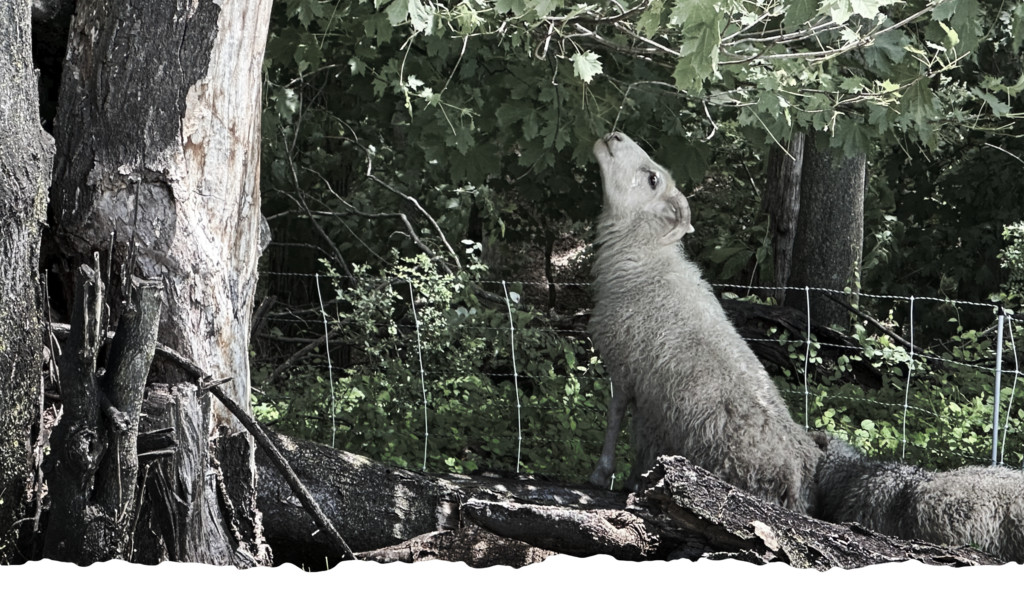
Our Icelandic sheep readily browse rose and bittersweet while largely leaving established spicebush, sassafras and pawpaw alone. They do not eradicate those introduced plants. They change their influence.
Dense vegetation becomes more open. Light reaches the ground. Native plants gain room to respond. The sheep turn some of that growth into wool, manure and fertility returned to the soil.
PROTECT RELATIONSHIPS, NOT PURITY
Help the land retain memory while remaining capable of change.
Native plants carry long relationships with the insects, fungi, birds, animals, soils and seasons of this place. Protecting those relationships sometimes requires limiting plants that have become disproportionately powerful.
Not everyone can keep sheep or goats. Animal browsing is one good form of control at the scale where animals and land can be responsibly managed, but there is no shortage of human hands or other appropriate tools.
Repeated cutting, pulling, mowing and weed whacking can change which plants are able to persist. Established native grasses often tolerate frequent trimming while Oriental bittersweet, garlic mustard and other plants may gradually lose vigor. In some circumstances, carefully targeted glyphosate applied to cut stems may disturb less soil than repeatedly clearing or uprooting an entire area.
The question is not whether an intervention is pure. It is whether the method fits the place, protects the relationships we value and helps living replacement become possible.
Ecosystems have always moved and changed. Our task is not to freeze the landscape in time. It is to participate with attention, humility and care.
GO DEEPER
Continue the conversation.
TAO ORION / FURTHER READING
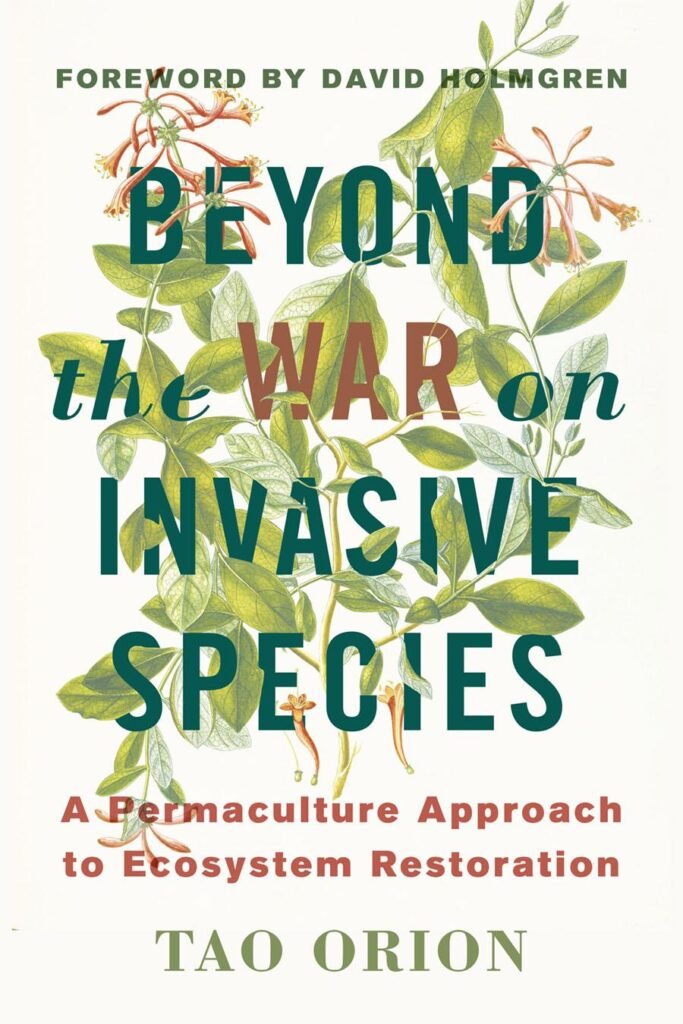
Beyond the War on Invasive Species
Tao Orion looks beneath the unwanted organism to the disrupted ecological processes that allowed it to flourish, asking how restoration can address causes rather than repeatedly attacking symptoms.
Affiliate link. Purchases may provide a small commission that supports the work at Dark Hollow.
ALLEN CLEMENTS / LEAVE A TRACE
Not conquest. Not absence. Participation.
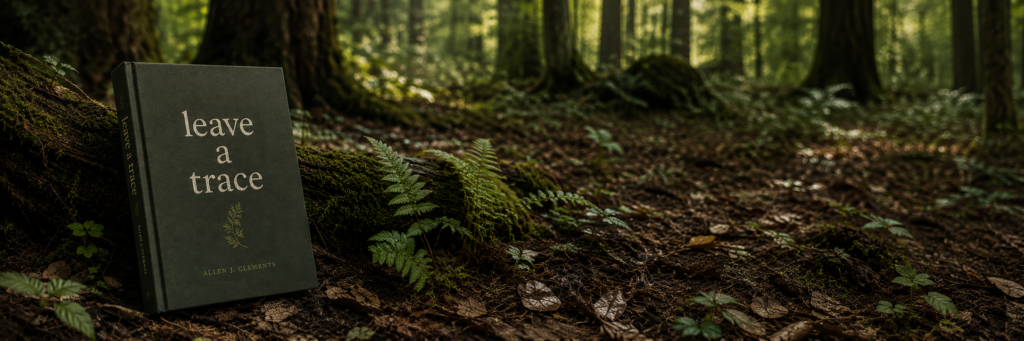
The larger philosophy behind our approach is explored in Leave a Trace, a search for a third way between human domination and human disappearance, and for the kind of trace our participation might leave.