
THE WORK / CARBON BALANCE
What the farm holds.
An honest carbon ledger for just 13 productive acres—what Dark Hollow stores, what it releases, and what its living systems make unnecessary.
Dark Hollow is a net carbon sink
CO₂e / year
The land currently absorbs and retains more carbon than the farm releases.
This working balance includes woodland, perennial pasture, silvopasture and erosion-control work—minus emissions from sheep, chickens, imported feed, hay and other farm activity.
See how we calculated it ↓FIELD NOTE / AN HONEST LEDGER
A sink is not the same as an absence.
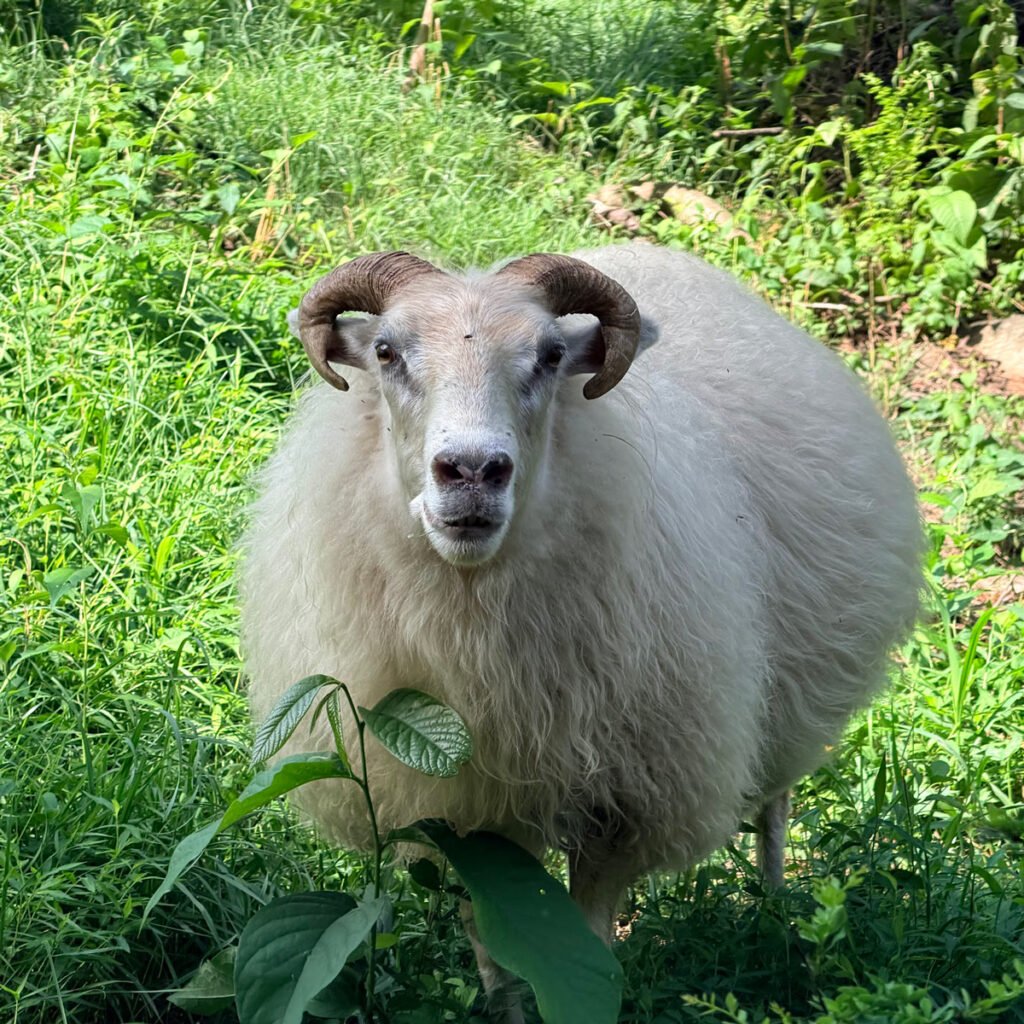
Dark Hollow is not carbon-free. Sheep produce methane. Chickens consume grain grown elsewhere. Hay, seed, tools, electricity and transportation all carry emissions.
At the same time, most of this farm remains under trees. Deep-rooted pasture replaces eroding ground. Silvopasture adds woody growth. Check dams retain soil and organic matter. Riparian and pond-edge plantings slow water before it leaves the land.
The point is not to make every enterprise look positive. It is to see the balance clearly enough to change it.
tree cover / forage / methane / manure / relationship
ANIMALS AS VECTORS
Their emissions are counted. So is the work they perform.
Sheep and chickens move benefits through the farm: carrying fertility, managing vegetation and interrupting insect and plant-pest cycles. Those functions can reduce reliance on purchased fertilizer, herbicides, pesticides and fuel-powered vegetation control—even though the avoided inputs are not automatically counted as carbon credits.
 Fertility vectorManure returns nitrogen and organic matter directly to productive ground.
 Vegetation vectorBrowsing, grazing, scratching and trampling reduce mowing, brush cutting and herbicide pressure.
 Insect vectorForaging chickens consume insects and disrupt some pest cycles, reducing the need for mechanical or chemical control.
WHAT 17 METRIC TONS FEELS LIKE
A number placed back into daily life.
Using current U.S. Environmental Protection Agency conversion factors, 17 metric tons is comparable to the emissions from:
These are communication equivalents, not offsets purchased or emissions erased elsewhere.
THE PRESENT BALANCE / WORKING ESTIMATE
What stores carbon. What releases it.
LAND-BASED BENEFIT
12–27 metric tons CO₂e / year
Growth of woodland and wooded pasture; developing silvopasture; perennial root systems; riparian and pond buffers; retained topsoil; and renewed vegetation below check dams.
FARM EMISSIONS
2–4 metric tons CO₂e / year
Five sheep and their winter hay; two runs of meat chickens and approximately 900 pounds of purchased feed; processing, transport, energy and small-equipment use.
ESTIMATED NET SINK
10–23 metric tons CO₂e / yearWorking midpoint: approximately 17 metric tons.
This is a working ecological estimate, not a verified carbon credit. The range is intentional.
ONE FARM / MANY KINDS OF WORK
Carbon is only one column in the ledger.
Each practice also changes what the farm may otherwise need to purchase, apply, mow, haul or repair. These substitutions are recorded as functions—not automatically claimed as carbon credits.
Protect the inherited reserve.
Carbon: the largest standing stock and annual sink. Other work: water retention, cooling, habitat, litter and soil formation. May reduce: clearing, mowing, brush treatment and externally sourced forest products.
Keep trees inside the grazing system.
Carbon: woody biomass plus understory and soil. Other work: forage, shade and invasive-plant management. May reduce: mowing, mechanical brush removal, herbicide and some imported forage.
Let agriculture grow upward.
Carbon: developing trunks, branches, roots and perennial cover. Other work: shade, habitat, forage and future food crops. May reduce: purchased fruit, nuts, fodder, fertilizer and vegetation control.
Build several root systems at once.
Carbon: fibrous grasses, taprooted chicory, legumes and root turnover. Other work: infiltration, erosion resistance and sheep forage. May reduce: synthetic fertilizer, some winter hay, reseeding and erosion repair.
Count the methane and the work.
Carbon: an emissions source held within a perennial grazing system. Other work: manure distribution, browsing, meat and wool. May reduce: purchased meat and wool, mowing, brush cutting, herbicide and fertilizer.
Feed enters. Meat and fertility remain.
Carbon: a net emissions source, principally because of approximately 900 pounds of purchased feed each year. Other work: meat, manure, scratching and insect consumption. May reduce: purchased chicken, fertilizer and some mechanical or chemical insect control.
Keep carbon-rich soil on the hill.
Carbon: retained organic matter, avoided topsoil loss and renewed plant growth. Other work: slower runoff and greater infiltration. May reduce: imported fill, erosion repair and downstream sediment cleanup.
Filter before water leaves.
Carbon: perennial roots and stabilized soil. Other work: filtration, bank stability, habitat and nutrient interception. May reduce: bank repair, mowing and erosion-control materials.
Return fertility through relationship.
Carbon: some plant carbon returns to soil, while decomposition also releases gases. Other work: nutrient cycling and biological fertility. May reduce: synthetic fertilizer, imported compost and soil amendments.
SUPPORT THE WORK
Help keep these 13 acres growing.
Dark Hollow is our home and farmstead. Planting trees, restoring water, caring for animals and measuring change require continuing investment.
Every form of participation helps fund the continued care, restoration and study of these 13 acres.
WHAT IF FARMS PARTICIPATED?
The important scale is acres changed.
Dark Hollow’s 17-ton midpoint should not be copied onto every farm. Our high share of woodland does much of the numerical work. A useful national question is smaller: how many acres could farms return to trees, perennial roots and protected water?
SMALL-FARM SCENARIO
19,000 acres≈14,600metric tons CO₂ / year at the EPA established-forest average
If just 1% of America’s approximately 1.9 million farms established or retained one additional acre of woodland, silvopasture or woody buffer, 19,000 acres would begin working differently.
LARGE-SCALE FARM SCENARIO
≈31,000 acres≈24,000metric tons CO₂ / year at the EPA established-forest average
If just 1% of the approximately 115,000 U.S. farms in the $1-million-or-more sales class devoted 1% of their average 2,727 acres to woodland patches, riparian buffers or silvopasture, roughly 31,000 acres would begin working differently.
These carbon figures are established-forest equivalents: a common reference point for the potential of woody cover, not immediate first-year credits. New woodland takes time to approach that rate, and working silvopasture or riparian plantings vary with tree density, climate, soil, species, survival and prior land use.
No single practice needs to carry the whole answer. Woodland patches, working trees, perennial roots and protected water can accumulate across a landscape.
METHOD / ASSUMPTIONS / LIMITS
The number should remain open to correction.
The estimate uses approximately 13 acres in two adjoining parcels: 7–8 acres of woodland outside the grazing area; 1.5 acres of wooded pasture; 1 acre of developing silvopasture; a 0.17-acre restored streamside buffer; a small native pond-margin buffer; and remaining pond, home, garden, driveway and infrastructure.
Work began in 2022. Diverse perennial seeding began in late 2024 and continued in 2025 and 2026. Five sheep rotate across the full 2.5-acre grazing system and consume approximately 30 bales of winter hay. Two annual chicken runs begin with 30 birds each and use approximately nine 50-pound feed bags per run.
Forest growth is calibrated against recent Pennsylvania Forest Inventory and Analysis stock change. Grassland, agroforestry and riparian estimates use conservative literature ranges. Erosion control receives limited credit for observed organic-matter retention and returning vegetation below check dams.
The estimate does not claim that all carbon already present was created by Dark Hollow. Existing woodland carbon is a protected stock. Potentially avoided purchases are described as functions, not counted as savings unless they truly replace something that would otherwise be bought or done.
Sources and reference points
- U.S. Forest Service — Forests of Pennsylvania, 2024
- U.S. EPA — Greenhouse Gas Equivalencies Calculator
- USDA Census of Agriculture — 1.9 million U.S. farms
- USDA Northeast Climate Hub — Agroforestry and climate mitigation
- USDA Agricultural Research Service — Adaptive multi-paddock grazing and soil carbon
Working estimate prepared August 2026. Future soil sampling, tree inventory, fuel records and repeated measurements should replace assumptions wherever possible.
THE FARM ORGANISM
Store more than we release.
Not by pretending that farming has no cost, but by keeping the cost visible inside a landscape capable of repair.
RETURN TO THE WORK →